Oakland runs on a workforce that rarely sits still — hospital staff at Kaiser and Highland, warehouse and logistics crews near the Port, childcare providers across Fruitvale and East Oakland, and commuters heading to jobs all over the East Bay. In a city this dense and this busy, knowing how to respond when someone collapses or gets hurt turns out to be a skill many residents genuinely need. American Red Cross CPR and First Aid certification classes teach those responses, and people look for them here for concrete reasons: a nursing program prerequisite, a new job requirement, a coaching role, or simply wanting to handle a scare at home. The training generally comes in a few forms — CPR, First Aid, CPR/AED, and combined First Aid/CPR/AED. Healthcare workers, students, teachers, caregivers, and parents all take part. What you actually need depends on what your employer, school, or licensing body asks for.
Quick Answer
Anyone searching for American Red Cross CPR and First Aid certification classes in Oakland can select a course that fits their circumstances — a healthcare or licensing requirement, a workplace safety role, a college or clinical program, childcare work, or personal preparedness. Because course content and acceptance vary from one requirement to the next, confirm exactly what you need before you register.
What American Red Cross CPR and First Aid Classes Cover
CPR stands for cardiopulmonary resuscitation. This training teaches the chest compressions and rescue breaths used when a person’s heart or breathing has stopped. First Aid training takes a wider view — it prepares people for the injuries and sudden illnesses that show up far more often than cardiac arrest, from cuts and burns to someone who suddenly feels faint. The two are usually taught side by side because an emergency doesn’t tell you in advance which response it will call for.
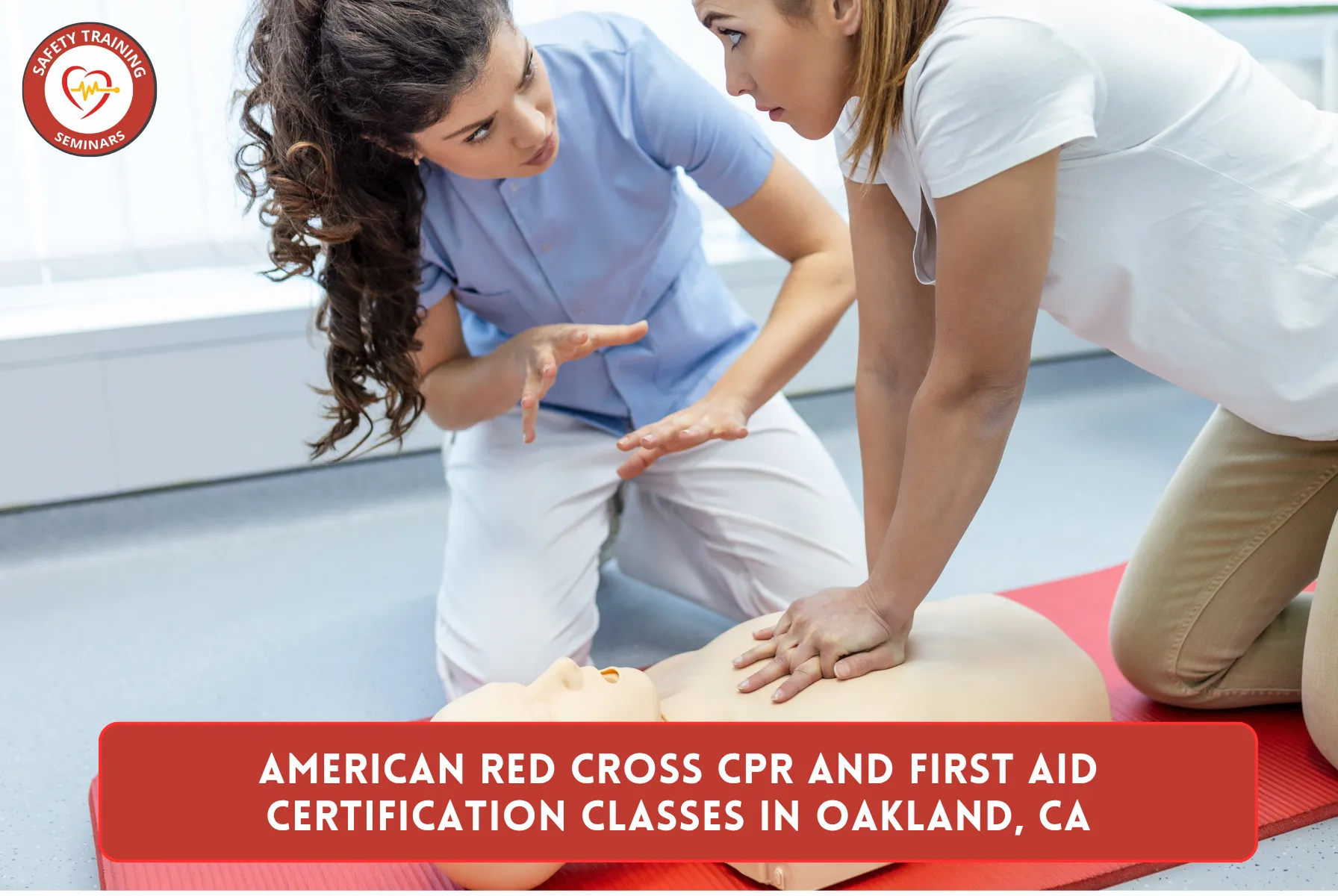
AED training belongs in the same conversation. An automated external defibrillator reads a person’s heart rhythm and can deliver a shock when one is needed, and many CPR courses build device instruction into the class. The exact topics covered depend on the specific American Red Cross course you enroll in, since not every class is built the same way. Because compressions and AED use are physical skills, hands-on practice tends to make them stick. Before signing up, check that a course’s format and content match what your workplace or program expects of you.
CPR Training in Oakland
CPR courses often teach across age groups. Adult CPR is a frequent starting point, while classes designed for parents, teachers, and childcare staff usually add child and infant methods, which change the hand position and the amount of force used. Many courses also include AED practice and repeated hands-on drills so the steps become second nature rather than something you’d have to recall under pressure.
For Oakland’s working population, the reason behind the training shapes the choice. A Kaiser or Highland employee, a fitness instructor near Lake Merritt, and a home caregiver in East Oakland may each need a different level. Healthcare-track students and clinical staff sometimes move toward provider-level training as they advance; you can compare CPR, BLS, ACLS, and PALS class options in Oakland to see how those tiers line up. What any given class includes still comes back to the specific American Red Cross course chosen, so pick the level that fits your goal.
First Aid and AED Training
First Aid training reaches into territory CPR alone doesn’t touch. It readies people for the everyday incidents that happen on a job site, in a classroom, at a warehouse, or at home — the situations that unfold before paramedics arrive. Combined with CPR and AED instruction, it gives a person a more complete set of responses for those first few minutes.
The people drawn to this combined training span many roles. Teachers and childcare providers frequently need it. Coaches, fitness professionals, caregivers, parents, community volunteers, and employees assigned to workplace safety duties often seek it out too. In a city with heavy foot traffic, large workplaces, and a wide range of community organizations, First Aid readiness carries real day-to-day value.
Who Typically Takes CPR and First Aid Classes?
Healthcare and medical personnel. Oakland anchors a large slice of East Bay healthcare — Kaiser Permanente Oakland Medical Center, Highland Hospital, UCSF Benioff Children’s Hospital Oakland, and Sutter’s Alta Bates Summit campus all draw clinical staff. Many of those roles call for current CPR or provider-level training, though requirements differ by position and facility.
Nursing and allied-health students. With Samuel Merritt University, Laney College, and Merritt College nearby, Oakland supports a steady population of students heading into nursing, EMT, and related fields. Certification is often needed before clinical placements begin.
Childcare providers and teachers. Licensed childcare settings and schools may require staff to hold current CPR/First Aid training, and those rules vary by employer and program.
Workplace and Port-area employees. Some businesses — including logistics and warehouse operations tied to the Port of Oakland — designate certain staff as emergency responders, roles that can involve CPR/First Aid training.
Parents and caregivers. Anyone responsible for children or aging family members often finds this training worthwhile even when no rule demands it.
Certification isn’t universally mandated across every job in these fields, so check your own situation instead of assuming.
How to Choose the Right Course
Ending up in the wrong class is a common and preventable mistake. The table below sketches the general purpose of each training type.
| Training Type | Typical Use |
| CPR | CPR-focused emergency-response training |
| First Aid | Response to common injuries and medical emergencies |
| CPR/AED | Combines CPR with AED-related training |
| First Aid/CPR/AED | Broader response training across several areas |
Read this as a general guide rather than a legal or employment rule. Whatever satisfies your requirement should be confirmed directly with your employer, school, healthcare organization, licensing board, professional association, workplace safety coordinator, or the training program. That one check keeps you from finishing a course that doesn’t end up counting.
Local Training Considerations in Oakland
Oakland’s density is part of the story here. Residents pull from neighborhoods like Fruitvale, Rockridge, Temescal, and the Grand Lake district, and many work not just in the city but across Berkeley, Alameda, Emeryville, and San Leandro. Getting to a class near BART or the I-580 and I-880 corridors often beats crossing the bridge or driving out of the county. The city’s mix of large hospitals, a working port, busy schools, and a deep bench of community and childcare organizations means the people looking for training rarely fit a single mold. If you want a class close to home, it helps to review Oakland CPR and BLS class details for the Fruitvale area alongside your options.
Safety Training Seminars in Oakland
Safety Training Seminars provides CPR and First Aid training for Oakland and the surrounding East Bay. Its Oakland–Piedmont center is located at 154 Santa Clara Ave., Suite 6, Oakland, CA 94610, in the Grand Lake and Piedmont Avenue area near Lake Merritt. Before choosing a class, it helps to settle a few questions: what level your role or program requires, whether you need CPR alone or a combined First Aid/CPR/AED course, and whether a hands-on format is part of what you need. Looking over the course details ahead of time — and confirming acceptance with your employer or school — makes it far more likely you’ll register for the right class the first time.
Why Consider Safety Training Seminars for CPR and First Aid in Oakland
A few practical points may help as you weigh your choices. Safety Training Seminars offers a local Oakland training location, provides CPR and First Aid course options, and keeps course information and registration accessible so you can review what fits before committing. For students, healthcare staff, and working parents balancing tight schedules, a nearby class saves time. Beyond location, the sensible move is to look closely at the specific course you’re considering and line it up with your real requirement rather than assuming any class will qualify.
Frequently Asked Questions
What CPR and First Aid classes can Oakland residents take locally?
Oakland residents can find CPR and First Aid courses within the city rather than driving out of the East Bay. Safety Training Seminars runs an Oakland–Piedmont center offering these classes. Since course levels and formats differ, confirm which class meets your workplace, school, or licensing requirement before you enroll.
Is CPR part of a First Aid class?
Not necessarily. First Aid centers on injuries and everyday medical situations, while CPR addresses cardiac and breathing emergencies. Some courses merge both into a single First Aid/CPR/AED class. Read the course description closely so you know which skills are included before you sign up.
Do Oakland healthcare workers usually need this training?
Frequently, yes. Staff at Oakland hospitals and clinics — and students heading into nursing or EMT programs at nearby schools — often need current certification, sometimes at a provider level. The exact requirement depends on the role and facility, so verify it with your employer or program rather than assuming.
Does the training include hands-on practice?
It can. CPR and AED skills are physical, and many classes include practice so learners build reliable technique. Formats vary between courses, though, so confirm whether the class you’re considering has an in-person, hands-on component if your requirement calls for one.
How do I pick between a CPR class and a full First Aid/CPR/AED course?
Start with why you’re training. A CPR-only class may cover a narrow requirement, while a combined First Aid/CPR/AED course handles a wider range of emergencies. Your employer, school, or licensing body usually names which one they accept, so confirm that before choosing.
Will my employer accept American Red Cross certification?
That depends on the employer. Acceptance varies by workplace, profession, and regulatory body, and some organizations specify a particular course or level. The safest step is to ask your employer or program what they require and confirm it before paying for a class.
Conclusion
CPR training prepares you for cardiac and breathing emergencies, while First Aid covers the broader range of injuries and sudden illnesses that come up in daily life — and in a city as busy as Oakland, many people benefit from a course that combines both with AED instruction. The point that matters most is matching the class to your actual requirement, whether it comes from an East Bay hospital, a nursing program, a childcare license, or your own family. Safety Training Seminars offers local CPR and First Aid classes for Oakland residents, so take a look at the course details, check what your employer, school, or organization expects, and enroll in the option that truly fits your situation.